Mouthparts
There are various kinds of mouthparts found in insects: chewing, siphoning, piercing-sucking, sponging.
Take a grasshopper, for instance. When it gnaws a grass blade, it does it not with teeth but with jaws: hard notched lamellas. It has two pairs of them!
Not only grasshoppers can gnaw and bite off, but also beetles, cockroaches, and many other insects.
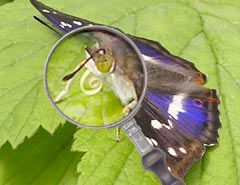
On the contrary, butterflies cannot do it. They have a different kind of mouth. To eat sweet nectar, butterfly does not need to open the mouth; its mouth is a long proboscis. When a butterfly does not eat, the proboscis is coiled. But once a butterfly sits down on a flower, it extends the proboscis and dips it into the nectar. This proboscis is nothing else but highly elongated jaws, grown together by sides. The proboscis’ length of Madagascar Macrosila predicta exceeds 25 cm!
The mouth of mosquitoes also looks like a long proboscis. It is formed by elongated needle-shaped jaws covered with lips.
How do bumblebees extract nectar from flowers?
They have a long flexible proboscis, which is formed by the lower jaw and lower lip and ends with a “tongue”. By this tongue bumblebees reach for nectar and lick it off.
In the same way bees collect nectar, though the bee’s tongue is shorter than that of bumblebee.
The mouths of flies are various. The housefly (Musca domestica) has a soft proboscis with a pad on its end. With it the fly licks food off.
A horse fly has a whole set of piercing and cutting instruments in its mouth. The reason for it is that horse flies feed on blood of animals, and to reach for the blood they need first to cut the skin.
Some beetles have huge upper jaws. For instance, the upper jaws of male horned stag beetles (Lucanus cervus) are like the antlers on stags. In the Darwin’s stag beetle (Chiasognathus granti), the upper jaws even exceeds the size of the rest of the body!
Yet, there are insects which in adult stage… do not eat at all. Therefore, they do not need mouth. They have no mouth at all!… Such are mayflies (Ephemeroptera) and male armored scales (Diaspididae).