Antennae
Structure of insects’ antennae is quite various; but normally the whole families, suborders, or even orders of insects are characterized by specific structure of antennae.
Usually antennae consist of a large number of segments, though in some insects they are short and contain few segments. Such are, for example, the antennae of flies and dragonflies: they are made of just 3 segments.
-3.jpg)
The antennae of beetles comprise normally 11 segments, those of hymenopterans (wasps, bees, ants, etc) — 12-13 segments.
The antennae of such animals as grasshoppers and some wood-boring beetles can be longer than the body.
Several forms of antennae are distinguished.
If an antenna, throughout the length, has approximately the same width, and widens in the end — this is a clubbed antenna. They are peculiar to butterflies.
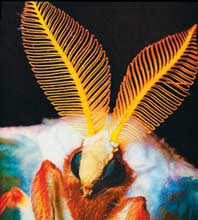
Moths, saturniids for instance, are characterized by feathery antennae. Such an antenna has lateral outgrowths on each segment.
If the first segment of an antenna is long and the other segments grow angularly to it, such an antenna is called geniculate. Sometimes, geniculate antennae end with a club consisting of fan-shape arranged lamellas (for example, in cockchafers).
There are other forms of antennae: setaceous (bristle-like), filiform (thread-like), moniliform (bead-like)…
What for do insects need antennae?
It turns out they need it for detecting odors! That is with the help of antennae insects… smell!
.jpg'))
It is in this way that insects discover and find food. In the same way, they find partners for mating. For example, males of the Actias selene come to a female, attracted by its scent, to 11 km; male gypsy moths — to 3.8 km.
Antennae are used also as tactile organs.
With their help, insects perceive also the temperature and humidity of the environment.
* * *
Tactile receptors are present not on the antennae only, but also on all parts of the body. Usually they have a form of hairs and bristles.
Movably attached hairs are also organs for perceiving movements of air including very faint ones — from another flying or walking insect.
In some cases such organs of sense replace completely the vision for the insect. An example of this is a blind cave beetle. Eyeless, it orients very well in its cave-home thanks to the sensitive antennae: with them the beetle smells and gropes its way; and if someone runs nearby, the beetle necessarily feels it, because its whole body is covered with sensitive hairs.
The photo of antennae of a saturniid is from http://nauka.relis.ru/33/0211/33211100.html