Black grouse
(Lyrurus tetrix)
.jpg)
It is like a domestic hen in size. Males (heath-cocks or blackcocks) are bluish-black, with the tail feathers lengthened and bent as a lyre on each side of the tail, with a white bottom of tail and bright red eyebrows. Females are reddish-brown, with fine black painting, a little bit less in size than males.
Males begin displaying in spring as soon as the ground is uncovered from winter snow. They gather usually on the ground, on open places with a good field of view — on large forest glades, sphagnum bogs, fields.
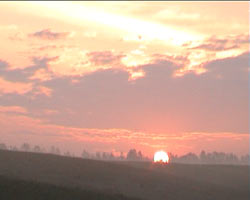
Let us imaging, that we are on one of such places… Dawn is only to begin soon. The dome of the sky is slightly brightened by the sun, which has not risen above the horizon yet. The space is filled with light mist… Suddenly a flock of blackcocks — with noisy flapping of wings — lands on the ground… Immediately, without preliminary preparations, a marvelous show begins: the males straighten their fine tails, lower the heads and begin to sing and whirl. They inflate the necks and loudly coo. And from time to time, extending the necks upwards and, as if rising on tiptoes, and frequently flapping the wings, they make their far-heard "chooff" sounds.
Usually, these birds are not one or two on a lek: they may be in a big flock — up to several tens or even more! And their songs, merging in a common solemn rumble, fill the space to kilometers. And females from all surrounding space fly to this call!…
Sometimes during a courtship display, males gather in pairs or threes and as if enter in fighting with each other. "As if" — because such a fight has no aggression in itself; it has only symbolical and demonstrative meaning. Simply, in such a way, males excite each other in order to show with even greater beauty their daring to females, which watch this show from some distance.
Usually, the courtship display lasts until the sun rises above the horizon. But in some flocks of blackcocks it is “accepted" to sing longer. We had occasions to observe such courtship displays. Also we could admire in all fullness the dances of these remarkable birds, sparkling in rays of the morning sun. It is interesting that some males, tired of so long dances, could fall asleep right on the lek among displaying companions. But the most tireless birds continue to dance and sing, and also to arrange extemporaneous "battles" attacking by breasts each other and increasing thus the common enthusiasm.
When the courtship display comes to an end, the flock of blackcocks flies to the nearest birch forest to eat birch catkins.
Black grouses live without forming married couples.
Their nests represent a small pit on the ground. The young can run out from the nest right after hatching. They learn to fly already from the age of two weeks.

Black grouses feed on seeds of cereals, berries, insects, and worms, and all winter long and beginning of spring — mainly on birch catkins and buds. In their stomachs, as in case of all representatives of the grouses family, always there are little stones, swallowed intentionally; these stones help to grind firm food.
The black grouse is not a bird of passage. It remains in that territory, where it hatched. When it is cold — it buries itself into snow and spends the night in a warm “cave”.
Its well-fledged toes allow moving easily over the surface of soft snow.