Hooded Crow
(Corvus cornix)
-10.jpg)
These birds are perfectly adapted to the neighborhood of man.
They build their nests of small branches on trees.
Eggs are incubated by the female, while the ‘husband’ feeds her during this period. In spring, one can often hear characteristic calling cry of a she-crow from the nest, tired of waiting for her husband.
We see these birds almost everywhere, so, observing them is easier than other birds.
If we are attentive, we can discover that their emotional sphere is rich of various states. For example, they can be very tender in relationships with each other; this is seen well in how they put in order each other’s plumelets.
And some crows are capable of radiating the emotions of love not only to representatives of their own kind, but even to people. They walk slowly on grass — and their well developed spiritual hearts shine with love! It is sad that so few people are capable of this!
They can also sing very tenderly. These sounds resemble something like “miaow” or “a-a-a” — in contrast to more habitual for us "kar-r-r”. Or, sometimes, they as if click the tongue. And they do this so absorbedly that involuntarily you get infected with their pleasure!
Ornithologists compare their intellectual level to 6-years old human children. However, not every adult can make out, for example, to soak a firm cracker in water, or to put a nut on rails to take its content after a tram passes…
Also crows like to play very much.
They can, similarly to human children, be amused with various objects, for example, to roll a ball lost by someone, or to have fun, sliding, as from icy mountains, from domes of temples wet and slippery after rain…
I had several occasions to observe, how a playful crow took in the beak an empty plastic cup and involved other crows, deceived into thinking that there is something tasty in it, into a game-pursuit…
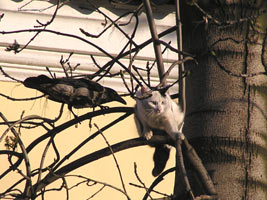
Crows also like to play even with cats by sneaking stealthily from behind so close, that the crow is about to peck the cat in the bum… And the cat has to run from it…
… Quite often one can observe situations when crow-fledglings, grown up to the size of adult birds, nevertheless, continue asking food from parents — even when the food is right at their feet, in the very direct sense… It was even more amusing to see how a fledgling, already of the parent’s size, standing in a puddle, asked to drink. And the parent satisfied its request: scooped water with its beak and poured it into the opened beak of the "kid".
Crows can live up to 70 years, accumulating crow’s wisdom.
Raven
(Corvus corax)
-3.jpg)
The raven is the largest representative of its family. It is approximately one and a half times larger than grey crow. Raven is completely black — as rook, but only much larger in size.
The raven has a remarkable voice when it sings. Its gentle guttural sounds resemble "kruik" and "korrk".
Ravens are very nice birds. They are very tender in relationships with each other. Married couples among them remain lifelong partners, and only the death of one of the birds forces another to look for a new mate.
In the air, they sometimes dance together: they freely and easily soar, rare flapping of the wings alternates with mutual somersaults. The entire sky space is filled with gentle sounding of their voices.
Ravens start nesting in very early spring. They build their massive nests usually on trees, and also on transmission towers. On their territory, which they never leave, the raven couple has several nests, which are used alternately — one during a season. Many nests are used for decades and are repaired only before each next settling.
Ravens can amazingly imitate the human voice if they live with people since childhood. But their habit to hide, at their own discretion, keys, glasses, money, and other small objects causes much trouble for main residents of the flat or house.
They also live for 50-75 years, but there are data about even longer terms.
Jackdaw
(Corvus monedula)
-4.jpg)
The Jackdaw’s size is approximately as of the blue rock pigeon; its color is black; the neck and top of the head are grey.
It nests frequently in settlements and cities, occupying attics, and also in hollows of trees in parks.
Fledglings leave the nest in the middle of summer. In autumn they form pairs; this is so-called "engagement". But they start breeding only from the third year of life.
In the temperate climatic zones, jackdaws winter in human settlements. There they can be met usually together with crows. But in the northern regions, jackdaws depart to winter to the areas with warmer climate, often joining flocks of rooks.
Jackdaws possess an excellent memory. They can, for example, remember for many years the person, who destroyed once their nest, and begin to cry alarmingly when that person appears. Moreover, they can teach it to the next generation.
These birds are easily tamed. They can mimic the human voice.
Magpie
(Pica pica)
-1.jpg)
This black-white bird has a very long tail.
It prefers to live near human habitation whereto it is attracted by presence of food.
Even in most severe winters, magpies remain in the area of nesting.
Magpies form constant pairs. Often one can observe how in early morning, they — in pairs — sit on tops of bushes or low trees and watch sunrise, obviously with pleasure.
Nests of magpies are big spherical (i.e. with a roof) constructions of twigs, with a side entrance. They are located in the thick of a bush or in the crown of a tree. The bottom of the nest is strengthened with clay; thus the nest remains durable for some years. Inside, the nest is lined with soft grass, moss, hair.
During the period of brooding, quite often one can see funny long magpie’s tails sticking out from the nests.
Magpie nestlings raised by people become strongly attached to them. But they cause many troubles because of their habit to hide all glittering things…
Jay
(Garrulus glandarius)
-3.jpg)
It is a very beautiful bird. Its plumage, in the whole, is smoky-reddish; but its main adornment is sky-blue plumelets on the wings.
Its typical call, which is easily recognized in the forest, resembles high-pitched duck’s "quack". Also an excited jay can make a sound similar to the call of the hawk. And do not be surprised if suddenly you hear in the forest shrill "miaow", as if someone has stepped over a cat’s tail — this sound, most likely, also is made by a jay.
In spring, it is possible to hear how jays sing for each other. These songs are very quiet and full of particular tenderness, as if the jays recall all gentle sounds known to them.
Imitation abilities of jays seem fantastic! Jays can imitate starlings, ravens, cats, people…


In the end of April or beginning of May, both spouses build a nest of branches. It can be located in a crown of a tree, but sometimes it is hidden inside a hollow or a birdhouse. Both parents brood the clutch alternately.
Though jays are omnivorous, their menu contains mainly vegetative food. They collect seeds of cereals, eat peas and beans, all kinds of berries and, first of all, acorns, which they take from trees or find on the ground.
Jays store acorns for winter. In some of such pantries, there can be up to several kilograms (!) of acorns.
Jay carries acorns in the craw, which can contain up to six acorns. The seventh acorn it carries in the beak. Having reached the place, it puts this acorn, digs a hole in the ground with its beak, pushes the acorn into it, stamps it, then puts the next acorn, and so on. Many such acorns get forgotten by jays and sprout next year. So, do not be surprised if you come upon a young oak in a birch forest!
Jays, who have not known human cruelty, are very sociable toward people in the forest. They, for example, can land on a branch of a tree very close to you — and start to sing very nicely with tender voice in its jay’s language: "Look, how beautiful I am! And I love you very much! I’ll be very glad if you give me something tasty!" It raises plumelets on the nape, assumes nice postures… And, of course, you give something delicious to this beautiful birdie!